American Fascism?

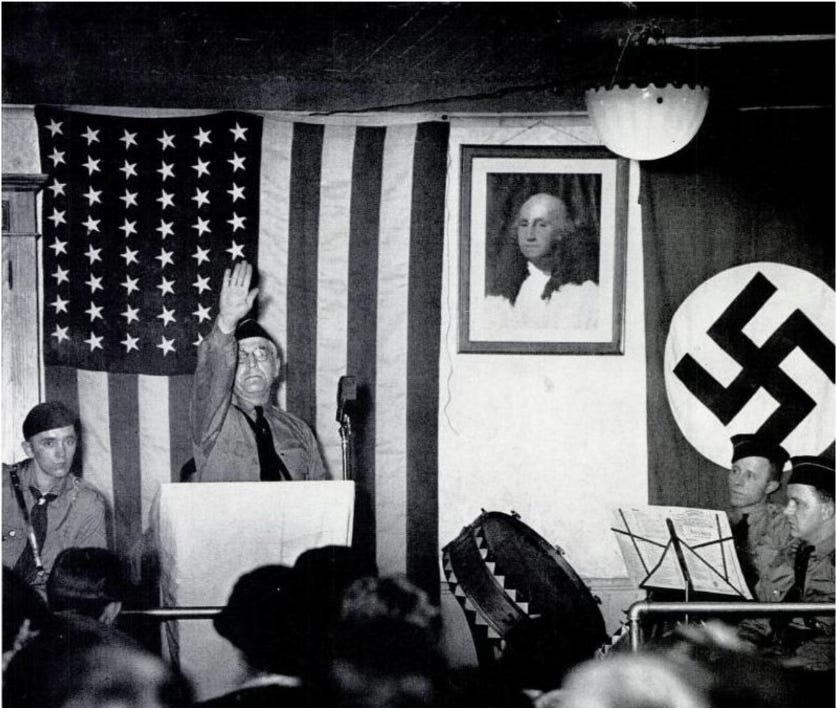
Until quite recently, pairing the words “America” and “fascism” felt like a category mistake, less because the United States was immune to authoritarian temptations than because its self-image and historical role seemed to foreclose the association. “Fascism” belonged, in the common sense of the term, to defeated European regimes: a pathology of interwar crisis and a cult of the Leader. The United States, by contrast, narrated itself as the guarantor of liberal constitutionalism and, after 1945, the principal architect of an anti-fascist world order. Even when scholars pointed to American traditions of racial domination, anti-labour violence, or Cold War securitisation, the word “fascism” still appeared too heavy, too European, too historically specific.
That hesitation is itself historically produced. The victory mythology of the Second World War did not simply place the United States on the “right side” of history; it became a civil religion. Anti-fascism was folded into national identity, into the legitimacy of American power, into the moral grammar of foreign policy. For over seventy years, that narrative acted like a conceptual prophylactic: if America is the champion of anti-fascism, then fascism must be something that happens elsewhere, an external enemy or a foreign contagion. The shock today is not only that illiberal tendencies have intensified, but that the old narrative no longer stabilises the situation. When the symbolic immunities fail, the repressed category returns: one finds oneself reaching for “fascism” not out of rhetorical excess, but because other terms, such as polarisation, populism, and democratic backsliding, begin to feel descriptively insufficient.
This is where the Weimar analogy becomes difficult to avoid. The point is not to claim identity between situations, nor to indulge in historical theatre. It is to notice a recognisable sequence: a legitimacy crisis of institutions; the normalisation of extraordinary measures; an opposition re-coded as an internal enemy; the conversion of legal mechanisms into instruments of personal rule; and the transformation of politics into a permanent plebiscite of loyalty. Weimar’s collapse was not simply the product of street violence; it was a process in which elites and institutions repeatedly miscalculated, believing they could “use” the radical right, contain it, bargain with it, or instrumentalise its energy against the left, until the radicals became the state. The lesson is not “history repeats,” but that democratic forms can be hollowed out by legalistic means, and that the line between constitutional procedure and constitutional sabotage is often crossed gradually, through a succession of “temporary” exceptions.
If the post-1945 order once made “America” and “fascism” appear incompatible, the present shift forces a rethinking of fascism itself. Fascism in the twenty-first century rarely arrives in the iconography of the twentieth: it is less likely to demand a total party-state in the classical sense than to operate through media ecosystems, juridical improvisations, and a fused apparatus of security, platform power, and moral mobilisation. It is not necessarily a revolution against the system; it can be a reconfiguration within the system, where elections persist but become rituals of humiliation for opponents, where courts are selectively revered or denounced, where the state’s coercive capacities are imagined as the Leader’s personal property. In this sense, “fascism” names not only brutality, but a kind of political transubstantiation: grievance is converted into transcendence, and transcendence into permission.
What is emerging can be described as an American variant of fascism: rooted in American exceptionalism, yet increasingly transnational in organisation and influence. This American version of fascism, long simmering beneath the surface, has now broken through at precisely the moment when its underlying contradictions have sharpened into seeming insolubility, i.e., contradictions long masked by the tides of neoliberalism. The genealogy of today’s fascist move in the United States must begin with its theopolitical foundations, which are inseparable from the long arc of its exceptionalism. Unlike the fascist movements of interwar Europe, which often mobilised Christianity only as an instrument for nationalist myth-making, or even turned against it in favour of neopagan or racialist cults, the American variant arises from within a specifically Protestant, Puritan tradition.
From the seventeenth century onward, the Puritan settlers imagined their polity as a “city upon a hill,” a covenantal community chosen by God and tasked with manifesting divine sovereignty in the New World. This founding myth fused religious identity with political legitimacy and cast the American experiment as a redemptive project for all of humanity. The theological structure of this covenantal exceptionalism had two decisive political consequences. According to Perry Miller, “protestant political thinking had never doubted … that God instituted government among men as a means toward their temporal felicity—or, at least toward their ‘safety’”(Miller 104). In this way, it sacralised the state’s sovereignty by rooting it in a prior covenant with God rather than in historical contingency or human consent. It also instilled a missionary orientation: the belief that America’s destiny was to serve as the vanguard of a universal order. This differs from European fascisms, which had to invent new political religions to fill the void left by secularisation.
Such a self-understanding made it possible for later movements, from Manifest Destiny to Cold War anti-communism, to interpret expansionism and even militarism as the fulfilment of divine mandate. In this sense, Christian nationalism in the United States is not a recent aberration but the culmination of a centuries-long theological-political formation. It draws upon the Puritan legacy in which the line between the ecclesial and the political was never sharply drawn. American exceptionalism was not merely a geopolitical doctrine; it was a millenarian narrative of national election, and it continues to furnish the cultural and symbolic resources for the American variation of fascism, one that frames authoritarian politics not as a betrayal of the nation’s origins but as a return to its sacred covenant. This exceptionalist theology hardened into a myth of America as a “New Israel,” a nation uniquely favoured by God, destined to bring light to the world. From the beginning, then, the American nation was conceived as both religious and political, both providential and territorial. This fusion of covenantal theology with statecraft is the seed of American Christian nationalism.
By the nineteenth century, Puritan exceptionalism had grown into the doctrine of Manifest Destiny. The expansion of U.S. territory westward was sacralised as divine will. Political leaders and preachers alike depicted the conquest of Indigenous lands as the fulfilment of God’s plan. Settler colonial violence was thus framed not only as a political necessity but as a sacred duty. Seen from this perspective, Trump’s proposal to take over Greenland becomes intelligible as part of a broader logic of exceptionalism and territorial appropriation. The phrase “Manifest Destiny” was coined in 1845 by the Democratic journalist and politician John L. O’Sullivan in the context of the debate over the annexation of Texas (Horsman 219). O’Sullivan invoked the term to describe what he saw as the inevitable expansion of the United States across the North American continent. In his editorials for the New York Morning News at the end of 1845, O’Sullivan argued that
Away, away with all these cobweb tissues of rights of discovery, exploration, settlement, contiguity, etc. ... [The American claim] is by the right of our manifest destiny to overspread and to possess the whole of the continent which Providence has given us for the development of the great experiment of liberty and federative self government entrusted to us. It is a right such as that of the tree to the space of air and earth suitable for the full expansion of its principle and destiny of growth—such as that of the stream to the channel required for the still accumulating volume of its flow. (O’Sullivan, qtd. in Merk 32).
For him, westward expansion was not an act of conquest but the fulfilment of a divine mission that fused the ideals of liberty and federated self-government with a sense of historical inevitability. A central feature of Manifest Destiny was its providential justification. O’Sullivan portrayed the United States as entrusted with a sacred mission. Expansion across the continent was thus cast not as imperial ambition but as the natural and moral outworking of this divine plan. This framing provided a powerful ideological foundation for U.S. territorial claims, rendering the annexation of Texas, and, soon after, the push for Oregon and California, as the realisation of a historical destiny rather than aggressive conquest.
At the same time, Manifest Destiny carried a distinct civilisational and racial dimension. O’Sullivan often contrasted the dynamic growth of the Anglo-American settlers with the perceived stagnation of Spanish America, the incapacity of Indigenous nations for “improvement,” and the fragility of European colonial footholds in the New World. Marx’s famous image of the “irresistible army of Anglo-Saxon emigration…armed with the plough and the rifle” reveals how expansion was imagined as both demographic inevitability and cultural superiority (Marx 9). Further, O’Sullivan wrote that “yes, more, more, more! .. . till our national destiny is fulfilled and . . . the whole boundless continent is ours” (O’Sullivan, qtd. in Merk 46). Although O’Sullivan was more optimistic about human progress than many of his contemporaries, he nonetheless regarded the spread of Anglo-American institutions, e.g., schools, courts, representative assemblies, mills, and meeting houses, as the mark of historical advancement.
Another defining aspect of Manifest Destiny was its challenge to foreign powers and to the European notion of a balance of power on the American continent. O’Sullivan rebuked European attempts to limit U.S. territorial growth, insisting that North America had been providentially given to the United States for its own expansion (Merk 41). Surprisingly, we heard the same words from Trump in the context of Venezuela, following his administration’s efforts to delegitimise and remove its president. O’Sullivan predicted that Canada would inevitably break away from Britain to join the United States and that no European power could resist the “simple, solid weight” of hundreds of millions of Americans destined to live under the Stars and Stripes.
Manifest Destiny is not merely a domestic programme of settlement but a hemispheric imagination of American pre-eminence that Trump now appears to reactivate. His claim that Canada should be incorporated into U.S. territory reads less as an offhand provocation than as a reprise of this foundational rhetoric. From its first appearance, the phrase entered political debate, attracting both praise and condemnation. Proponents used it to justify westward expansion, especially during the annexation of Texas and the Mexican-American War, presenting territorial growth as a benign historical necessity. Critics, by contrast, saw it as a cloak for imperialism and as a means to extend the reach of slavery into new territories (Horsman 211). The dual character of Manifest Destiny, as an ideal of liberty and progress, and as a rationalisation for conquest, made it one of the most contested concepts of the mid-nineteenth century.
In retrospect, Manifest Destiny can be understood as a theopolitical ideology that joined together ideas of providence, progress, and racial hierarchy to legitimate territorial expansion. It laid the ideological groundwork for a distinctive form of American exceptionalism, portraying the nation not as an empire among empires but as the chosen agent of a universal historical mission. This vision would shape U.S. policy in the nineteenth century and leave a lasting imprint on its political culture, reappearing in later doctrines of expansion and intervention. The phrase coined by O’Sullivan thus captured more than a moment of territorial ambition; it crystallised a narrative of national destiny that has remained central to today’s political imagination. The genocidal logic of Manifest Destiny illustrates one of fascism’s enduring traits: the myth of decline and rebirth, which requires the purification of the nation through the elimination of internal and external enemies. Here, Indigenous peoples were marked as obstacles to America’s divine destiny, to be displaced or annihilated in the name of providential sovereignty.
In the twentieth century, evangelical Christianity was mobilised as an ideological weapon in the Cold War. Under President Eisenhower, the phrase “under God” was inserted into the Pledge of Allegiance, and “In God We Trust” was adopted as the national motto (Kruse xvi). Evangelist Billy Graham became the unofficial pastor to the nation, preaching a fusion of Christianity and anti-communism. Here again, the American project fused religion and politics, this time against a global enemy. Communism was not only a political adversary but an anti-Christian force, depicted as atheistic, immoral, and satanic.
In this context, evangelical Christianity became an instrument of state power, reinforcing the view that America’s political mission was inseparable from its religious destiny. The religious rhetoric that had once unified Americans became a source of conflict by the Nixon era. Efforts to revive the Eisenhower model of public religiosity, by recruiting the same religious leaders, conservative donors, civic groups, and even patriotic entertainers, failed in a changed political climate. Instead of fostering unity, slogans like “one nation under God” highlighted and deepened the country’s internal divisions, as exemplified by local battles over school prayer (Kruse 274).
The Cold War consolidated the view that the nation’s survival required religious faith. This fusion of religiosity and geopolitics laid the groundwork for later forms of Christian nationalism, which would translate anti-communism into culture wars against feminism, secularism, and multiculturalism. Running alongside these historical developments was the persistent thread of anti-intellectualism in American culture. Richard Hofstadter famously traced this tradition back to the populist rejection of elites, intellectuals, and universities, which were seen as alien to the common sense of “the people” (Hofstadter 15). For Christian nationalism, this anti-intellectualism translated into suspicion of secular knowledge. Universities, scientists, and critical thinkers were cast as corruptors of faith and enemies of the nation. Revelation and biblical literalism took precedence over reasoned debate. This cultural disposition made American populism particularly receptive to authoritarian religion, where obedience to scripture and leadership replaced deliberation and critique.
The late twentieth century saw the crystallisation of these genealogical currents in the rise of the Moral Majority. Founded in 1979 by Jerry Falwell, the Moral Majority emerged initially as a reaction to desegregation. Evangelical leaders had opposed federal mandates to integrate Christian academies, framing their resistance as a defence of “religious liberty” (Balmer 25). Though abortion and family values soon became the movement’s public rallying cries, its origins lay in a defence of white supremacy under theological cover. The Moral Majority and later organisations such as the Christian Coalition, founded by Pat Robertson in 1989, transformed evangelical religion into a powerful political bloc. Their agenda targeted abortion, LGBTQ rights, feminism, and secular education, framing each as evidence of national decline. Here, the logic of fascism became more apparent: a myth of cultural degeneration caused by internal enemies, demanding rebirth through moral purification and authoritarian politics.
Evangelical leaders did not shy away from political elitism. They claimed a direct mandate from God, positioning themselves as intermediaries between divine will and national destiny. The masses were mobilised through populist rhetoric, but always subordinated to the authority of charismatic religious elites. This fusion of populist mobilisation and elitist sovereignty mirrors the immanent multiplicity of fascism itself. In the twenty-first century, Christian nationalism has only intensified. The post-9/11 climate of fear, combined with the polarisation of American politics, provided fertile ground for apocalyptic rhetoric. Evangelical leaders framed the “War on Terror” as a battle between Christianity and Islam, good and evil. Domestically, culture wars deepened as evangelical groups fought against same-sex marriage, reproductive rights, and secular education.
By the 2010s, figures such as Franklin Graham and younger activists like Charlie Kirk and his Turning Point USA advanced an explicitly nationalist theology, framing America as a Christian nation under siege. The 2020 election and the January 6th insurrection exposed the full extent of this convergence. At the “Jericho March” preceding the Capitol riot, pastors invoked biblical warfare, blowing shofars and calling for the walls of tyranny to fall. For participants, storming the Capitol was not merely a political protest but a spiritual battle, a defence of God’s nation against satanic enemies. Taken together, these genealogical elements, Puritan covenant theology, Manifest Destiny, Cold War anti-communism, anti-intellectual populism, and the Moral Majority, formed the conditions of possibility for today’s transformation of fascism in the United States.
Unlike its European counterparts, which often subordinated religion to politics, the fascist movement in the country sacralises politics through religion itself. Its theological core gives it an apocalyptic temporality: compromise is heresy, pluralism is sin, and politics is spiritual warfare. At the same time, its populist rhetoric conceals its elitist structure: the masses are mobilised but ultimately subordinated to the authority of charismatic leaders, whether pastors, prophets, or political figures. Christian nationalism, then, is not simply a conservative subculture. It is the theological engine of American fascism, preparing the ground for the fusion of populism, elitism, and authoritarianism that defines fascist politics.
Central to the fascist logic of Christian nationalism is its apocalyptic temporality. Politics is framed not as negotiation or compromise but as a battlefield between good and evil. The language of “spiritual warfare” saturates evangelical political discourse, casting opponents not as legitimate adversaries but as demonic forces (Gorski and Perry 7). This eschatological worldview makes democratic pluralism impossible. One cannot compromise with evil; one can only defeat it. Evangelical leaders frequently invoke biblical battles, e.g., Jericho, Armageddon, and the Exodus, as analogies for contemporary politics. The Jericho March in December 2020, preceding the storming of the Capitol, exemplified this logic. Protestors blew shofars, prayed for walls of tyranny to fall, and demanded the divine restoration of Trump to office.
In their imagination, the election was not a contest of votes but a cosmic struggle between God’s will and satanic corruption. This apocalyptic framing transforms political opponents into existential enemies. Democrats, feminists, secularists, and immigrants are not simply wrong but evil. In fascist terms, this logic echoes the myth of national decline and rebirth: the nation has fallen into sin and must be reborn through purification, which often entails violence. The paradox of Trump’s popularity among evangelical Christians has been widely noted. A thrice-married casino magnate hardly fits the mould of pious leadership. Yet within the theological-political logic of Christian nationalism, Trump could be reimagined as a messianic figure.
Evangelical leaders frequently described Trump as a “Cyrus” figure, an imperfect but divinely chosen ruler who nonetheless advances God’s plan. Evangelical support for Trump was neither an aberration nor simply a matter of political expediency. Their enthusiasm for Trump was “the culmination of evangelicals’ embrace of militant masculinity, an ideology that enshrines patriarchal authority and condones the callous display of power, at home and abroad” (Du Mez 3). His personal flaws became evidence of divine providence: only God could have chosen such an unlikely vessel. In this way, Trump became not only a political leader but a quasi-biblical figure, sanctified by his role in defending Christian America against its enemies.
This fusion of charismatic leadership and divine election resonates with fascism’s elitist structure. The masses are mobilised through populist rhetoric, “the forgotten men and women,” but their energy is directed toward submission to a transcendent leader, portrayed as the sole bulwark against national collapse. The paradoxical messiah is at once populist and elitist, ordinary in speech but extraordinary in mandate. American Christian nationalism thus exhibits all the structural features of fascism, translated into a religious register: America is portrayed as having fallen into decadence through feminism, secularism, multiculturalism, and globalism. Its rebirth requires purification through Christian sovereignty. Evangelicals believed themselves “custodians of morality” and “worried that the sexual revolution, civil rights movement, second wave feminism, and gay rights movement signalled a society in collapse” (Dowland 54).
Political opponents are recast as demonic forces. “Globalists,” “liberal elites,” immigrants, and secular educators are not adversaries but existential threats to Christian America. For this agenda, politics is aestheticised liturgically, sacralising collective passion. Rallies resemble revival meetings, with music, prayer, and ritualised chants. Alongside this, conspiracy serves as a myth. From QAnon to election denial, conspiratorial narratives provide the unifying mythos. They transform scattered grievances into a coherent cosmic battle, giving meaning to resentment and legitimising violence.
In Deleuze and Guattari’s terms, these practices reveal how fascism operates not only as a political regime but as a micro-political investment of desire. It captures affects, e.g., fear, resentment, and ecstasy, etc., and binds them to authoritarian projects. In the American case, these effects are coded religiously, turning worship into political mobilisation. At its core, the theocratic turn of Christian nationalism is a rejection of secular democracy. Liberal constitutionalism rests on the separation of church and state, the plurality of beliefs, and the negotiation of difference. Christian nationalism, by contrast, insists that the nation can only be legitimate if it recognises Jesus Christ as sovereign. Democracy is acceptable only insofar as it delivers biblical outcomes. When it does not, it is cast as illegitimate, corrupt, even satanic.
This rejection became evident in the 2020 election and its aftermath. For millions of Christian nationalists, Trump’s loss could not be real; it had to be fraudulent, because God could not allow His chosen leader to be defeated. Here, electoral legitimacy was subordinated to theological legitimacy. The January 6, 2021, coup attempt was not merely political extremism but the expression of a deeper theopolitical conviction: that divine sovereignty overrides democratic procedure. The American case thus illustrates a distinctive form of fascism: theopolitical fascism. The American derivation of fascism draws centrally on theology. It sacralises the nation as God’s chosen people, aestheticises politics as revival liturgy, and legitimises authoritarian sovereignty through apocalyptic temporality.
This is not to deny the role of race; indeed, Christian nationalism remains deeply intertwined with white supremacy. But its structure is theological before it is biological. It is not only the racial nation that must be purified but the Christian nation. If we describe today’s U.S. political movement as a form of fascism, articulated in a distinctly Christian key, it should be understood as a mutation of the fascist form, and thus as further evidence of fascism’s capacity to adapt to new historical conditions. It fuses populism and elitism, desire and discipline, myth and sovereignty, into a theocratic politics that prepares the ground for authoritarianism. Reconfigured fascism in the United States through evangelical Christianity and fused with the residues of Cold War anti-communism, helped supply an ideological warrant for last year’s coup attempt in South Korea. As European fascism once did, this American variant now projects itself outward, shaping international politics on a global scale.
My contention is that Trump’s emergence is not a rupture in American history but the endpoint of a trajectory embedded from its very inception. From the outset, the dream of a theocratic order rooted in Puritan Christianity animated significant strands of Anglo-Protestant settlement and state formation; today’s Christian nationalists read Trump as the figure destined to fulfil that long-standing aspiration. Even where Democrats oppose Trump’s particular methods, they often remain aligned with key premises of this deeper trajectory, above all, the civilisational myth of American exceptionalism and the fusion of national destiny with moral providence. It is this paradoxical delusional grandiosity, sustained by Christian nationalist movements, that threatens to unravel what postwar America constructed and to push the country into systemic turbulence.
References
Balmer, Randall H. Bad Faith: Race and the Rise of the Religious Right. Eerdmans, 2021.
Dowland, Seth. Family Values and the Rise of the Christian Right. U of Pennsylvania P, 2015.
Du Mez, Kristin Kobes. Jesus and John Wayne: How White Evangelicals Corrupted a Faith and Fractured a Nation. Liveright, 2020.
Gorski, Philip S., and Samuel L. Perry. The Flag and the Cross: White Christian Nationalism and the Threat to American Democracy. Oxford UP, 2022.
Hofstadter, Richard.Anti-Intellectualism in American Life. Vintage, 1963
Horsman, Reginald. Race and Manifest Destiny: The Origins of American Racial Anglo-Saxonism. Cambridge, MA: Harvard UP, 1981.
Kruse, Kevin M. One Nation under God: How Corporate America Invented Christian America. Basic Books, 2015.
Marx, Karl, “The American Question in England,” New York Daily Tribune, 1850.
Miller, Perry. Nature’s Nation. Cambridge, MA: Harvard UP, 1967.
An interesting analysis, sort of ‘fascism with American characteristics’. Nothing about class though. Nothing about the wages system of slavery. Nothing about how the chattel slavery of the South was tied to private property as a sacred right. I think one could write a similar essay about Revisionist Zionism, you know, the covenant with God and all, leading toward God is my landlord, complete with the Commandment, ‘Thous shalt not kill’ and the slaughter of the Canaanites. Of course, the dictatorship of the capitalist class began with the legitimation of chattel slavery along with the national liberation of the bourgeois from monarchist rule from Britain and taxation without representation. The thing is that the Scope’s Monkey Trial people have been able to get into State power, mainly because 20 million workers in the U.S. didn’t even bother to vote. Trump won the popular vote by one million. In other words, the problem is the political ignorance of the working class, especially the socially conservative workers.
America became the principal architect of anti fascist world order?? Isn’t it the Soviet Union that was the biggest?